

Author: Kalpit Kadia
Senior Field Application Engineer, GetWireless
What is 5G RedCap?
5G RedCap stands for 5G Reduced Capability. It’s a version of 5G Radio Access Technology designed for devices that don’t need the full throughput of 5G but still want to take advantage of 5G RAT.
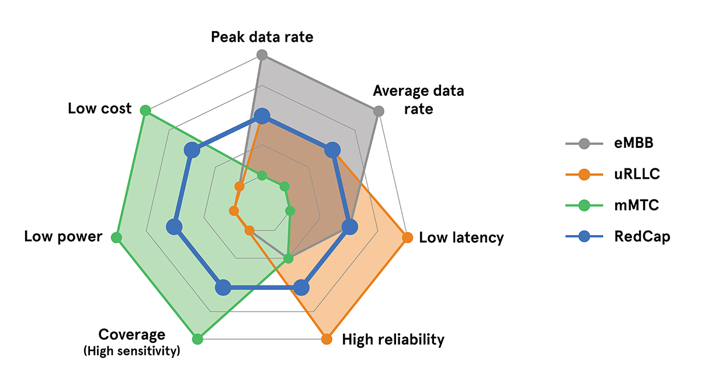
5G RedCap, standardized in 3GPP Release 17, is a trimmed-down version of 5G NR. It removes features that many IoT and mid-tier devices don’t need—such as extremely wide bandwidths and complex antenna configurations—while preserving key advantages of 5G.
5G RedCap is a next-generation standard for mid-speed connectivity. Unlike regular 5G, a 5G RedCap device has a simpler radio design and modem and operates on narrower bandwidths. Its unique capabilities make it a key enabler of mid-speed IoT use cases.
5G RedCap vs. Traditional 5G
Designed with specific use cases in mind, RedCap offers a more efficient approach to 5G connectivity that balances performance, cost, and energy efficiency.
Key Differences Between 5G RedCap and Traditional 5G include:
Simpler Design: 5G RedCap modems have a simpler design compared to traditional 5G modems. 5G RedCap requires only two cellular antennas compared to the four cellular antennas required in traditional 5G modems.
Power Consumption: Due to the simpler two-antenna design in 5G RedCap devices, it consumes less power compared to traditional 5G devices. This helps 5G RedCap devices extend battery life in battery-powered applications.
Data Throughput: 5G RedCap devices provide download speeds up to 220 Mbps and upload speeds up to 120 Mbps, which are lower than traditional 5G device data speeds but fast enough to handle most video and data streaming applications.
Cellular Spectrum: 5G RedCap devices use the cellular network spectrum more efficiently, as compared to traditional 5G devices. This enables network operators to use the spectrum more efficiently and effectively when more 5G RedCap devices are using their network.
5G RedCap Applications/Use cases:
5G RedCap devices can be used in any application that requires moderate data throughput, cost-effective solutions, power saving, and future-proofing.
Some areas of application include smart metering, agriculture sensors, smart parking infrastructure, smart streetlights, video surveillance, health and fitness monitoring devices, and many more.
Why is 5G RedCap a “sweet spot”?
5G RedCap (Reduced Capability) is considered a “sweet spot” because it provides the optimal balance of performance, cost-efficiency, and power consumption for a vast range of IoT and industrial applications that do not require the full data speed capabilities of traditional high-end 5G.
Key Reasons 5G RedCap Hits the Sweet Spot:
Optimized Performance: 5G RedCap delivers sufficient data rates (Up to ~220 Mbps downlink and ~120 Mbps uplink) and lower latency compared to LTE Cat-4 devices, which is ideal for applications like video surveillance, industrial monitoring, and smart cities.
Reduced Complexity and Cost: 5G RedCap offers a reduced two-antenna design and a cost-effective solution compared to traditional 5G devices.
Power Efficiency: 5G RedCap devices, due to simpler design, use less power compared to traditional 5G devices.
Future-Proofing and 5G Integration: RedCap is a native 5G standard(3GPP R17) that operates on 5G Standalone (SA) networks. This ensures long-term viability as 4G networks are eventually phased out. It also retains core 5G advantages like network slicing, enhanced security, and mobility management.
At GetWireless, we supply and support 5G RedCap-capable cellular modules, modems, and routers.
Please reach out to get your 5G RedCap project started!
Reference links:
https://www.sierrawireless.com/iot-blog/5g-redcap-vs-traditional-5g-what-you-need-to-know/
https://www.telit.com/blog/what-is-5g-redcap/